What Is Flat Roof Home Insurance?
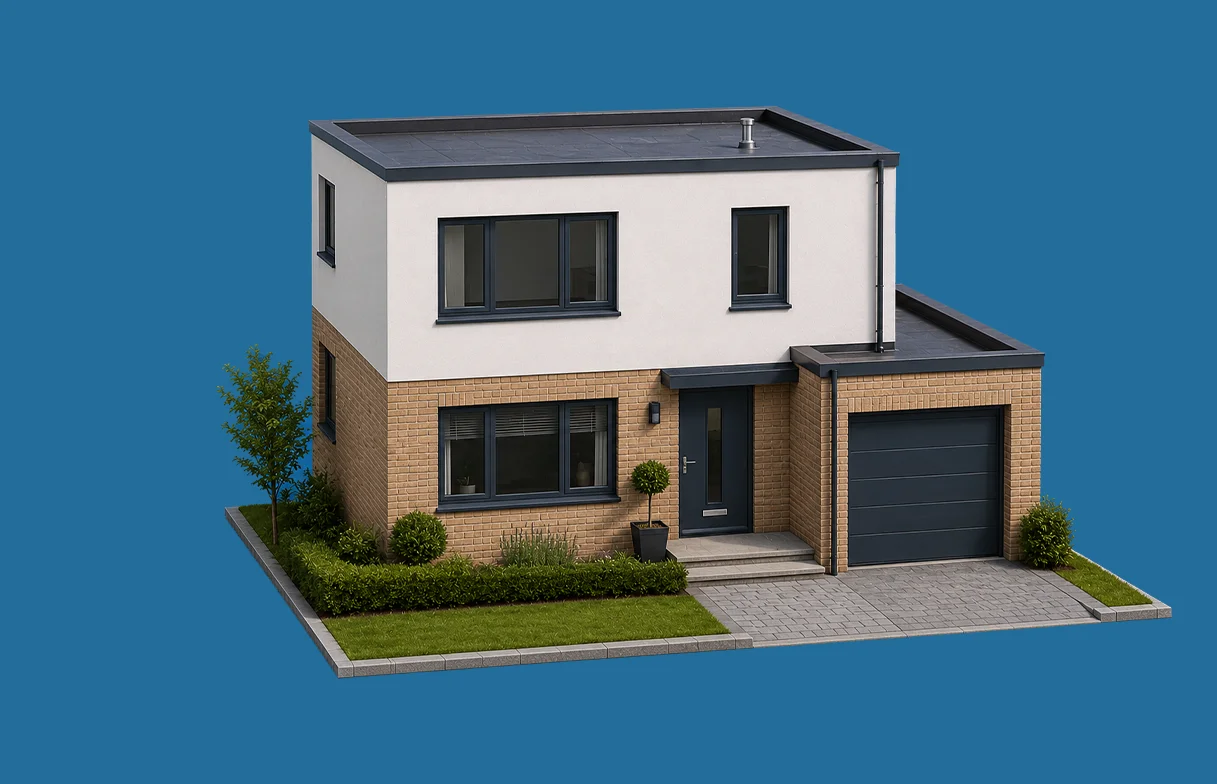
Flat roof home insurance is specialist buildings and contents cover designed for properties where part or all of the roof is flat or low-pitched, defined by insurers as a slope of less than 10 degrees.
Standard home insurance is designed for conventionally constructed properties with fully pitched, tiled or slated roofs. A flat roof departs from this standard and introduces specific risk factors, primarily the elevated potential for water pooling, leaks, and weather damage, that standard underwriting systems either cannot accommodate or apply restrictive exclusions to accommodate.
The key practical question for homeowners is how much of their roof is flat. Above a threshold, typically 25% to 30% of total roof area, though this varies by insurer, a property is classified as non-standard construction for insurance purposes, and specialist underwriting is required.
Below the threshold, standard cover is usually available, potentially with a loading. The threshold applies to the main dwelling; outbuildings such as garages or garden rooms with flat roofs are typically assessed separately
The most important fact about flat roof insurance that competitors do not explain
Not all flat roofs are equal in the eyes of an underwriter. The material your flat roof is made from has as much impact on your insurance terms as the percentage of the roof that is flat. A recently installed EPDM rubber or GRP fibreglass roof, with lifespans of 30 to 50 years, is viewed very differently from a 15-year-old felt roof approaching the end of its serviceable life.
Homeowners who have upgraded their flat roof to a modern material have substantially improved their underwriting position, regardless of percentage. This distinction is explained in full in the materials section below.
When Does Your Property Need Specialist Flat Roof Insurance?
The answer depends on three factors: the percentage of flat roof, the material, and the age and condition of the covering. The following guidelines reflect current standard practice across most specialist underwriters, though exact thresholds vary.
Flat roof % of total roof area | Standard insurer response | Specialist insurer response |
|---|
Under 25% | Usually covered, sometimes with a premium loading. Disclosure still required, failure to disclose invalidates cover. | All specialist underwriters will cover. Good terms available especially with modern materials. |
25–30% | Threshold zone, some standard insurers cover with conditions, many require specialist referral or apply exclusions. | Straightforward for specialist market. Material, age, and condition are the main pricing factors. |
31–50% | Most standard insurers decline or apply heavily restricted FLEA-type cover excluding the most relevant perils. | Specialist cover available. Material type, age, and maintenance record are key underwriting factors. Good terms achievable with modern roof. |
51–75% | Standard insurers typically decline entirely. Comparison sites will not return usable quotes. | Specialist market access required. Achievable cover for properties with modern materials (EPDM, GRP) and up-to-date inspection records. |
76–100% | Standard insurers decline. Often applies to purpose-built flat-roof homes, some bungalows, and modern architecture. | Available through specialist underwriters. Condition, material, age of roof, and maintenance history are the primary underwriting factors. Higher premiums reflect genuine elevated risk. |
How to Calculate Your Flat Roof Percentage
When applying for flat roof home insurance, you will be asked what percentage of your total roof area is flat. This is a reasonable question — flat roofs represent a specific and quantifiable risk — but it is one that many homeowners find difficult to answer accurately. Here is how to do it.
Step-by-Step: Calculating Your Flat Roof Percentage
Identify all roof sections: Walk around your property and identify every roof section, the main pitched roof, any flat-roofed extensions, dormers, porches, integral garages, bay window roofs, outbuildings. Note which sections are flat (slope less than 10 degrees).
Estimate the area of each section: For each section, estimate its approximate footprint area in square metres. You can do this using satellite imagery (Google Maps or Google Earth), your homebuyer's survey (which will include approximate dimensions), or by measuring the exterior walls below each roof section.
Calculate total roof area and flat roof area: Add up all roof section areas to get total roof area. Add up only the flat sections. This does not need to be exact, a reasonable estimate is what insurers expect. Round to the nearest sensible bracket (0–25%, 26–33%, 34–50%, 51–75%, 76–100%).
Check your homebuyer's survey: If you had a homebuyer's survey or building survey when you purchased the property, it should include roof information. This is the most reliable source of flat roof details if available.
If uncertain, get a roofer's assessment: For complex roof arrangements or if you want a definitive figure for insurance purposes, a roofer or building surveyor can measure and certify the flat roof percentage. This also gives you a current condition report, a document useful both for insurance and for future maintenance records.
Never under-report your flat roof percentage
If you provide an inaccurate flat roof percentage, whether deliberately or through a genuine mistake, and this inaccuracy is identified at the time of a claim, your insurer may reduce the settlement proportionately or decline the claim entirely on the basis of non-disclosure of a material fact. If you are unsure of your flat roof percentage, provide your best estimate rounded up rather than down, and note that it is an estimate. An accurate declaration is always preferable, even if it means a higher premium.
Flat Roof Materials: How Your Covering Affects Your Insurance
The material used on a flat roof is one of the most significant underwriting factors, more significant than most homeowners realise, and barely discussed by any of the comparison site guides.
Understanding how insurers view different materials gives you both practical information for your insurance application and a compelling case for investing in a modern flat roof system if your current covering is approaching end of life.
Material | Expected lifespan | Insurer appetite | Insurance premium impact | Key notes |
|---|
EPDM Rubber | 30–50 years | ✓ Excellent | Most favourable terms available. Modern, seamless, excellent waterproofing, UV stable. | Currently the most popular residential flat roofing material in the UK. Single-sheet installation minimises joint failures, the most common leak point. EPDM's long lifespan and low maintenance needs make it the underwriting-preferred material. If your flat roof has been upgraded to EPDM, declare this explicitly. |
GRP Fibreglass | 30–40 years | ✓ Excellent | Equivalent to EPDM — very favourable terms. | Seamless, hard surface with excellent waterproofing and UV resistance. Ideal for flat roofs with foot traffic (terraces, balconies). Slightly more expensive to install than EPDM but equivalent insurance terms. Installation quality matters, GRP requires specialist installation. |
Mastic Asphalt | 20–30 years | ⚠ Good | Acceptable terms — experienced specialist market. | Traditional, long-standing material with proven track record. Relatively expensive to install but durable. Accepted by most specialist underwriters with appropriate maintenance history. More common on older properties and commercial buildings. |
Modified Bitumen / Torch-on Felt | 20–25 years | ⚠ Acceptable | Standard specialist market terms when relatively new and well-maintained. | Improved version of traditional felt, the three-layer system with a gas torch creates better waterproofing than mineral felt. Widely used and accepted by specialist underwriters when the installation is relatively recent and the roof is in good condition. |
Traditional Mineral Felt | 15–20 years | ⚠ Cautious | Elevated premiums, potential for restrictive conditions, may require inspection evidence. | The original flat roofing material, cheapest to install but shortest lifespan and most prone to leaks, UV degradation, and thermal movement damage. Underwriters view old or deteriorating felt cautiously. The age of the felt covering is a key question — felt approaching 15+ years will attract more restrictive terms or require evidence of recent inspection. |
Asbestos cement | N/A — requires specialist management | ⚠ Restricted | Specialist handling required. Everywhen will consider up to 49% on referral. | Asbestos-containing materials are no longer permitted in new construction and require specialist removal and disposal. If your flat roof contains asbestos cement (common in properties built or extended between 1930 and 1970), specialist insurer referral is essential. Some specialist insurers cover this but with specific conditions around the material's condition and containment status. |
Upgrading from felt to EPDM or GRP: the insurance case
If your existing flat roof is covered in ageing felt and approaching end of life, the insurance case for upgrading to EPDM or GRP is strong. A new EPDM or GRP roof will: cost approximately £60–£130/m² installed; last 30–50 years (EPDM) or 30–40 years (GRP) with minimal maintenance; carry manufacturer warranties; and materially improve your underwriting position, often resulting in lower premiums and fewer restrictive conditions.
On a typical 25–30m² extension flat roof, the premium savings over 10 years can partially offset the additional cost of the higher-quality material.
Why Standard Home Insurance Fails Flat Roof Properties
Standard home insurance underwriting systems are calibrated for a specific risk profile: a fully pitched, tiled or slated roof, in standard condition, with no unusual structural features. A flat roof introduces risk factors that this system cannot accommodate without applying conditions that defeat the purpose of the cover.
The primary risks that make flat roofs a different underwriting proposition are:
Water pooling and drainage failure
Unlike pitched roofs where water runs off immediately, flat roofs collect water in any low points or drainage blockages. Pooled water accelerates material degradation, increases load on the structure, and creates the conditions for leaks. Regular gutter and drain maintenance is a specific insurance condition for this reason.
Storm and weather damage
Flat roofs are more vulnerable to storm damage than pitched roofs — particularly from high winds, hailstones, and the accumulated weight of snow. The ABI confirmed UK insurers paid £322 million for storm, heavy rainfall, and frozen pipe damage in Q2 2025 alone. Flat roof properties are disproportionately represented in storm damage claims.
Thermal movement and material stress
Temperature cycles cause flat roof materials to expand and contract. On poorly installed or ageing covers, this thermal movement cracks joints, splits membranes, and creates leak paths. Modern EPDM and GRP are specifically designed to accommodate thermal movement; traditional felt is more vulnerable.
Burglary risk
A flat roof adjacent to an upper window provides a platform for intruders to access the upper floor without ladders. Insurers factor this into both buildings and contents premiums. Anti-climbing measures, anti-climb paint applied to appropriate surfaces, window locks, and monitored alarm systems, can help mitigate this risk and potentially improve insurance terms.
Maintenance dependency
Flat roofs require more active maintenance than pitched roofs, regular visual inspection, gutter clearing, debris removal, and prompt repair of any identified defects. Neglect accelerates deterioration significantly. Standard insurers' automated systems cannot accommodate the maintenance-dependent risk profile; specialist underwriters apply maintenance conditions explicitly.
Repair cost unpredictability
The cost of flat roof repair or replacement is difficult to predict from a standard rebuild calculator, it depends heavily on material type, extent of damage, and whether deck replacement is required. Specialist underwriters assess reinstatement costs individually for flat roof properties.
Policy Conditions: What Specialist Flat Roof Insurance Requires
Specialist flat roof insurance is achievable for properties with all roof percentages and most materials — but it comes with conditions that must be actively maintained throughout the policy period.
These conditions are not obstacles: they are the practical risk-management measures that keep your property insurable and your claims valid.
Professional Inspection Requirement
Most specialist flat roof policies require periodic professional inspection of the flat roof to confirm it is in a satisfactory state of repair. The typical interval is every 5 to 8 years. Homeprotect requires an inspection at the time of quoting if the roof is more than a certain age; Everywhen requires inspections every 8 years as a general condition.
The inspection should be carried out by a qualified roofer or building surveyor, not a general contractor, and the resulting inspection report should be retained. At claim time, the insurer will ask for evidence of inspection and maintenance; without it, a claim for roof-related water ingress may be attributed to lack of maintenance and declined.
Maintenance and Drainage
All flat roof insurance policies require the roof to be maintained in a state of good repair. In practical terms this means: gutters, drains, and outlets must be kept clear of debris; any pooled water on the roof must be addressed promptly; any identified defects (cracked membrane, failed joint, standing seams beginning to lift) must be repaired promptly, not deferred; and any areas of visible deterioration must be assessed professionally and addressed before they develop into leak paths.
Security Conditions
Given the elevated burglary risk that flat roofs present (providing a platform to access upper windows), specialist flat roof policies typically require that all external doors have appropriate locks (five-lever BS3621 mortice deadlocks on timber doors, or equivalent), and that opening windows adjacent to or accessible from the flat roof have key-operated locks.
Some policies specify anti-climbing measures or monitored alarm conditions, particularly where the flat roof provides direct access to an upper floor.
How to reduce your flat roof insurance premium
MoneySuperMarket notes that waterproofing, drainage improvements, and insulation all reduce insurer risk assessment and can lower premiums. From a broker perspective, the most effective premium reduction measures for flat roof properties are: upgrading from felt to EPDM or GRP (material-based improvement); providing a current professional inspection report (condition evidence); installing monitored alarm and anti-climbing measures (security improvement); maintaining drainage and clearing gutters regularly (maintenance demonstration); and increasing the voluntary excess (risk-sharing commitment).
Each of these signals to underwriters that the risk is actively managed and active management of a flat roof reduces the most common claims scenarios significantly.
What Specialist Flat Roof Insurance Covers
Buildings damage from storm, fire, flood, escape of water, theft, malicious damage, and subsidence — assessed with full knowledge of the flat roof construction
Repair or replacement of the flat roof covering itself following an insured event (storm damage, fire, or impact) — not general wear and tear
Trace and access costs, finding and accessing the source of a leak, including removal and reinstatement of internal finishes
Alternative accommodation if the property becomes uninhabitable following an insured event
Contents cover for furniture, electronics, clothing, and personal possessions, including any loading for elevated theft risk from flat roof security profile
Property owners' liability, essential if contractors, estate agents, or visitors access the property
Legal expenses cover for disputes related to the property, including planning and boundary issues
Home emergency cover, typically 24/7 access to plumbing, electrical, and roofing emergency contractors
What flat roof insurance does not cover
Flat roof insurance explicitly does not cover: gradual deterioration and wear and tear of the flat roof covering, insurers cover sudden insured events, not the natural aging of roofing materials; damage that arises from lack of maintenance, if the roof was already deteriorating before the storm that is cited as the damage cause, the insurer may decline the claim; the cost of routine maintenance, re-felting, or planned roof replacement at end of life; and damage arising from DIY or unqualified roof work.
Knowing what is not covered is as important as knowing what is, particularly for flat roof properties where the boundary between insured events and maintenance obligations is frequently disputed.
How Performance Direct Arranges Flat Roof Home Insurance
Full property assessment including roof details
We take a detailed account of your flat roof — percentage of total roof area, material, age of the current covering, date of last inspection, and any known maintenance work. We also note the property's construction, age, and any other non-standard features. The more accurate the information we gather, the better the terms we can obtain from specialist underwriters.
Material and condition assessment guidance
If your flat roof is aged felt approaching end of serviceable life, we will advise you honestly on how this affects the insurance market and what options are available — including whether a professional inspection report would open up better underwriting options. If your roof has been upgraded to EPDM or GRP, we ensure this is accurately captured and presented to underwriters who will reward it with better terms.
Specialist underwriter market access
We access specialist non-standard underwriters — including some Lloyd's of London capacity — that are not available through comparison sites. These underwriters assess each flat roof property individually rather than applying blanket restrictions based on automated system parameters. A flat roof property that a comparison site returns no quotes for can often be insured at reasonable terms through the specialist market.
Clear explanation of all policy conditions
Every flat roof policy comes with conditions — inspection intervals, maintenance requirements, security standards. We explain every condition clearly before you commit, highlighting any requirements that might need action (such as arranging an inspection before the policy incepts, or installing specified security measures) and ensuring you understand what the policy requires to remain valid.
Claims advocacy if something goes wrong
Flat roof claims, particularly escape of water or storm damage claims, are frequently disputed on the grounds that damage was caused by wear and tear rather than an insured event. As your independent broker, we work for you in the claims process: helping you present evidence of maintenance and inspection, advocating for a fair assessment of the damage cause, and ensuring the settlement reflects your genuine reinstatement costs.
~5% of UK broking firms hold Chartered status
Chartered Status Matters for Flat Roof Insurance Claims
Flat roof claims are among the most frequently disputed in domestic home insurance, the boundary between an insured event (storm damage) and excluded maintenance failure (gradual deterioration) is often contested.
Chartered Insurance Broker status means our team brings professional-standard knowledge to both the placement and the claims process: we understand what evidence is needed to support a storm damage claim on a flat roof, how underwriters assess cause of loss for water ingress, and how to advocate for a fair outcome on your behalf.
This professional standard, legally enforceable, not just aspirational, is the practical difference between a broker who arranges the policy and one who actively supports your interests when it matters most.
Get a Quote for Flat Roof Home Insurance
Whatever the percentage of your flat roof, whatever material it is covered with, and whatever its age, Performance Direct can arrange specialist insurance that genuinely reflects your property's construction and risk profile.
Call our specialist team directly for complex flat roof situations, properties with high flat roof percentages, ageing felt, or a combination of flat roof and other non-standard features are best assessed in conversation to ensure we present the risk accurately to the right underwriters.
Get a Quote Online Call Our Specialist Team
Other Non Standard Home Insurance We Arrange
Flat roof properties are one of a wide range of non-standard construction types that Performance Direct insures. If your property has additional non-standard features, listed building status, subsidence history, thatched roof, or timber frame, we can arrange cover that addresses all relevant factors in a single specialist policy.
Non Standard Hub
Get a Flat Roof Quote
Whatever percentage of flat roof you have, and whatever material it is covered with — we can find specialist cover. Complex cases are best discussed directly.
Flat Roof %: Standard Insurer Thresholds
How the percentage of flat roof affects standard insurance cover
Under 25%Standard OK
Most standard insurers cover — may charge loading
25–30%Threshold zone
Some standard insurers cover; some require specialist
31–50%Specialist needed
Standard insurers typically decline — specialist broker required
51–100%Specialist only
Specialist underwriting required — all percentages insurable in good condition
Material Lifespan at a Glance
EPDM Rubber — 30–50 years — ✓ Excellent
GRP Fibreglass — 30–40 years — ✓ Excellent
Mastic Asphalt — 20–30 years — ⚠ Good
Modified Bitumen — 20–25 years — ⚠ Acceptable
Traditional Felt — 15–20 years — ⚠ Cautious
Non Standard Home Insurance
Useful Resources
ABI Home Insurance Guidance›
BIBA Find Insurance›
Roofing Superstore Advice›